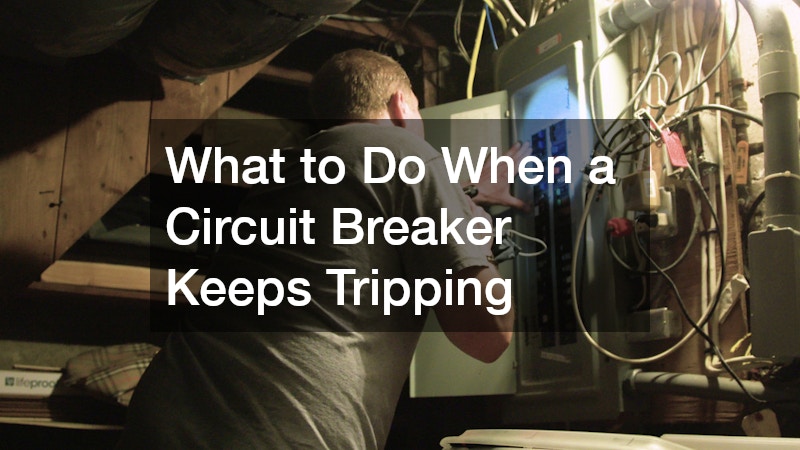
A circuit breaker that keeps tripping is one of those household problems that’s easy to dismiss — reset it once, and it feels solved. Reset it three times in a week, and it’s clearly telling you something. The question is whether the cause is a simple overload you can fix in an afternoon or a wiring fault that puts your home at genuine risk. Getting that diagnosis wrong has real consequences, both for safety and for your wallet. This guide walks through the likely causes, what you can safely handle yourself, and when the situation calls for more than a reset.
Why Breakers Trip — and What Each Pattern Tells You
A breaker trips for one of three reasons: the circuit is carrying more current than it’s rated for, something on that circuit has developed a short circuit, or the breaker itself is failing. Each scenario has a distinct pattern worth recognizing before you touch anything.
Overloaded circuits are the most common trigger. If the breaker trips only when multiple high-draw appliances run at the same time — a hair dryer and a space heater on the same bathroom circuit, for instance — you’re asking a 15-amp or 20-amp circuit to carry more current than its design allows. The fix is usually behavioral: redistribute loads rather than reset and repeat.
Short circuits and ground faults present differently. A breaker that trips immediately when you flip it back on, or one that trips the moment you plug in a specific appliance, points to a short circuit — either inside the device or in the wiring itself. Ground faults behave similarly but involve current leaking to a grounded surface rather than completing the intended path. Both are more serious than an overload and shouldn’t be dismissed.
A worn-out breaker is underappreciated as a cause. Breakers have a finite mechanical life, and one that trips under a load it previously handled without issue — especially in a panel more than 25 years old — may simply be failing. This matters because a degraded breaker can also fail to trip when it should, which is the more dangerous outcome.
- Check whether the trip happens under a specific load combination or immediately upon reset, since that distinction narrows the cause significantly.
- If a single appliance reliably triggers the trip, test it on a different circuit before assuming the wiring is at fault — the device itself may have a failed component.
- Note whether the breaker feels hot to the touch or has any visible discoloration on the panel face, both of which suggest internal damage rather than a simple overload.
What You Can Fix Yourself — and the Limits of That
Redistributing electrical loads is well within DIY territory and often resolves chronic tripping without any electrical work at all. A 20-amp kitchen circuit tripping because it’s running a countertop convection oven, a coffee maker, and a microwave simultaneously is an overload problem, not a wiring problem. Moving one appliance to a circuit on the opposite leg of the panel spreads the current demand and may eliminate the issue entirely.
Replacing an outlet protected by a GFCI device — the type with test and reset buttons found in bathrooms and kitchens — is also something most homeowners can handle safely, provided the power to that circuit is confirmed off at the panel before any work begins. A non-contact voltage tester, which costs roughly $15 to $25, removes any ambiguity about whether a circuit is actually de-energized.
Replacing the breaker itself is where the calculus shifts. The wiring at the panel remains energized even when the main breaker is off in many service entrance configurations, and contact with those leads is potentially fatal. Some experienced DIYers do replace individual breakers, but it requires a clear understanding of which conductors remain live and why — this is not a task to approach based on a single tutorial.
Homeowners sometimes underestimate short circuit repairs. Finding the fault location inside a wall or junction box takes methodical testing with a multimeter, and splicing wiring incorrectly creates fire hazards that may not show up immediately. The repair cost of hiring licensed electricians to locate and fix a short circuit — typically $150 to $400 depending on complexity — is modest compared to the risk of leaving a fault in place.
Upgrading Circuits and Panels — When the Problem Is Structural
Chronic tripping sometimes isn’t a fault at all — it’s a capacity problem. Homes built before 1980 were wired for a fraction of the electrical load that modern households place on them. A single home office with a desktop, two monitors, a laser printer, and a space heater can easily draw more current than an older bedroom circuit was designed to handle continuously.
Adding a dedicated 20-amp circuit for a high-draw appliance or workspace is the appropriate fix when load redistribution isn’t practical. Dedicated circuits are required by the National Electrical Code for specific appliances — refrigerators, dishwashers, and HVAC equipment — and are strongly advisable for any single device that draws more than half a circuit’s rated capacity on its own.
Panel upgrades become relevant when there are no available breaker slots, when the panel is a recalled brand (Federal Pacific Stab-Lok and Zinsco panels have documented reliability problems), or when the service entrance is undersized for current demand. A 100-amp service was considered sufficient for decades but can be genuinely inadequate in a home with electric vehicle charging, a heat pump, and induction cooking.
The cost comparison matters here. Adding a single dedicated circuit runs approximately $200 to $400 in most markets. A full panel upgrade from 100 to 200 amps typically falls between $1,500 and $3,500, depending on the complexity of the existing service. Neither is cheap, but both are far less expensive than the property damage — or worse — that an overtaxed panel can eventually cause.
- Ask an electrician whether your panel has available capacity before assuming an upgrade is necessary — many older panels have open slots that can accept additional breakers.
- If your home still has a Federal Pacific or Zinsco panel, treat replacement as a safety priority rather than an elective upgrade, regardless of tripping frequency.
Making the Panel Safer Going Forward
Once the immediate tripping issue is resolved, a few practices meaningfully reduce the likelihood of future problems.
Arc fault circuit interrupters, known as AFCIs, detect the specific electrical signature of arcing faults — the kind that cause roughly 30,000 home fires annually according to the U.S. Consumer Product Safety Commission. The National Electrical Code now requires AFCI protection in most living spaces for new construction and significant renovations. Retrofitting them into an existing panel is one of the higher-value electrical upgrades available to homeowners, typically $40 to $75 per breaker installed.
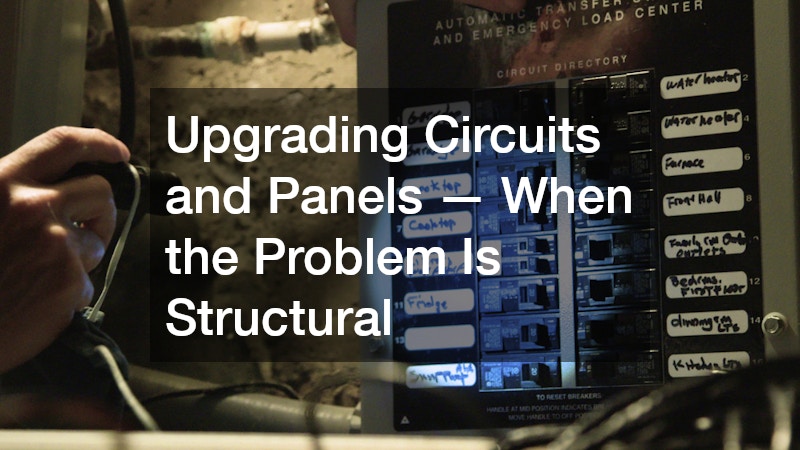
Label your panel accurately. It sounds mundane, but a panel with vague or incorrect labels — “bedroom 1/2” covering three separate circuits — makes load diagnosis far harder than necessary. A Saturday afternoon with a plug-in circuit tester and a helper can produce a complete, accurate map of every circuit in the home.
- Replace any breaker that has tripped more than 10 times in a single year, since repeated mechanical stress accelerates wear and reduces the reliability of the thermal-magnetic trip mechanism.
- Install a whole-house surge protector at the panel level if your area experiences frequent thunderstorms — these devices, priced between $100 and $300 installed, protect appliances from voltage spikes that standard breakers are not designed to handle.
Deciding Whether to Reset, Repair, or Call a Professional
The reset-and-wait approach is defensible exactly once, for a breaker that’s clearly tripped due to an obvious overload. Beyond that, the pattern of tripping carries real information that gets more serious the longer it’s ignored.
If you’ve redistributed loads, tested the appliances involved, and the breaker still trips regularly, the wiring or the panel itself needs attention. Electrical faults don’t stabilize on their own — they tend to worsen, and the transition from nuisance tripping to an arcing fault inside a wall happens without warning. Treat persistent tripping as a diagnostic finding that demands resolution, not a quirk to work around. A straightforward inspection rarely costs more than a service call fee, and it tells you exactly what you’re dealing with.